Last
time, we went through a brief overview of cooling systems: what parts
constitute the "cooling package," some of the issues in cooling system design,
and a breakdown of the cooling airflow into stations for analysis.
Now,
let’s move on to that analysis. We’ll follow the path of air from some upstream
location as it enters and passes through the cooling system. The first obstacle
it will encounter is the inlet, and on most cars today that inlet comes with an
obstruction: the grill.
 |
| Even in the central "open" portion of this Kia Telluride grill, inlet flow will encounter significant obstructions due to the styling elements. These dissipate energy and reduce total pressure. |
Grill/Inlet:
State a to State 1
If
your car has a grill, there will be a loss in total pressure between a
and 1 due to friction and separation around the slats. This can be significant—on
the order of 10-20% (normalized to freestream velocity), according to Aerodynamics of Road Vehicles—and it
is one reason why sports cars often eschew grills completely.
 |
| High-performance cars, like my old 2002 Viper (above) or the C8 Corvette (below), often have no grill or mesh in the inlets to heat exchangers. Contrast this with “normal” cars which tend to have highly stylized and ornamented grills (like the Kia above). These impediments to flow have a detrimental effect on inlet efficiency; that’s the price of vanity. |
But
the grill isn’t the only potential issue at the cooling air inlet.
Additionally, there may be separation around the opening—a source of
interference drag. Porsche’s famous "fish mouth" foam test is meant to
model these effects even with a closed
cooling air opening so that cooling drag can be measured more accurately.
So,
the first testing we need to do is to determine if we have separation around
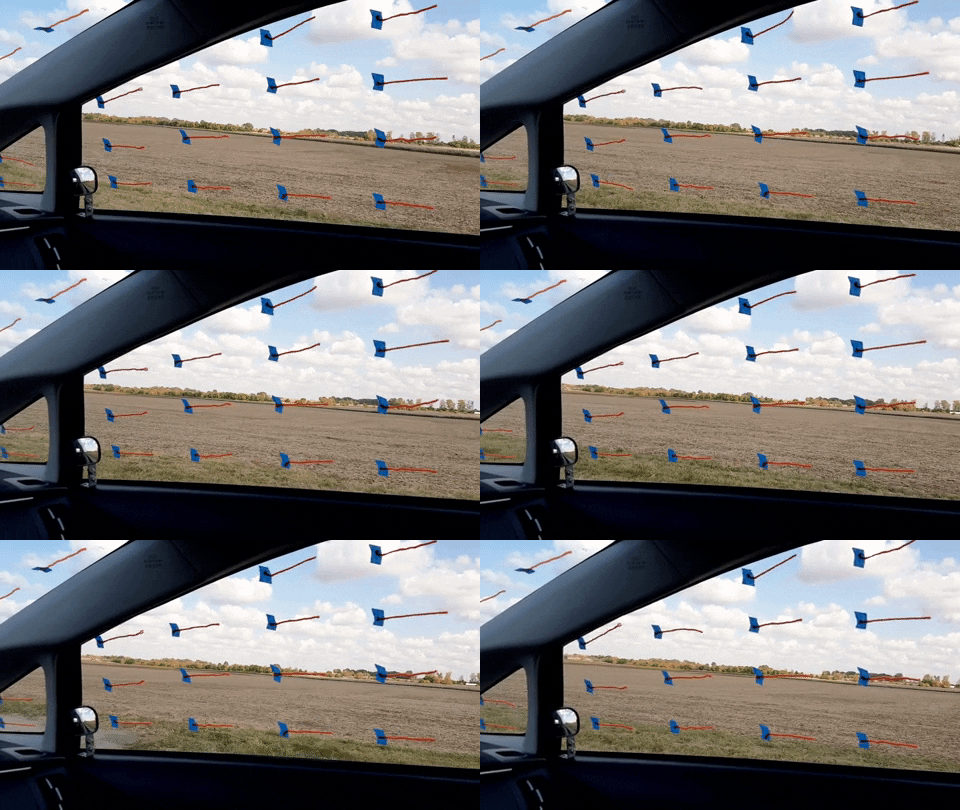
the grill opening. Tape tufts to your car and observe their behavior
around the grill. If the tufts lay flat against the body and generally align, there is no
separation.
 |
| In addition to the tufts bending under the car around the stock splitter (where I later discovered the flow is losing a lot of total pressure), the tuft next to the license plate shows separated flow. For this and other reasons I’ll explain later, one of the modifications I will make to improve cooling system performance is to move (or remove) the license plate. |
 |
| Adding a splitter extension below the inlet changes the flow pattern—you can see the tufts over top of the splitter board now point straight back into the opening rather than wrapping down and under the car. The flow around the license plate bracket is also improved. |
Next,
to check for capture area we can measure the difference between static pressure
in the ambient state and 1. If p1 > pa,
the streamtube captured by the inlet is smaller than the actual opening and
some of the flow will "spill" around the grill area. If p1
< pa, the capture area is larger than the actual opening.
Fix
a static pitot tube to a pole at the front of your car and tape a pressure
patch in the middle of the grill opening on the centerline of the car, then measure the gauge
pressure at a target speed or over a range of speeds.
Your
results may look like this:
Positive
CP here means an increase in static pressure from ambient.
This is good—it means the streamtube captured by the cooling air opening is smaller
than the physical inlet area, and because the streamlines expand as they
approach the grill, the flow recovers some static pressure from the total
pressure available as it slows down. However, as vehicle speed increases, this
effect becomes less pronounced; the streamtube capture area gets larger and less
pressure is recovered.
As
a side note, this is exactly the opposite behavior of jet engines. Subsonic and
transonic engines (supersonic aircraft use movable surfaces to create a series of standing shock waves in the inlet duct, while transonic inlets typically don't have variable inlet geometry) have inlet openings sized for "design condition" (left side of the image below), which is typically
cruise or another high-speed flight segment.
In off-design flight segments like takeoff, where speeds are low but mass flow
requirements are high, a jet engine will capture a streamtube larger than the
physical inlet opening i.e. p1 < pa. At cruise
or design condition, where speed is high but mass flow requirements are low, p1
> pa. Thus, CP increases with speed:
 |
| (J. Rovey, AE433 Airbreathing Propulsion Notes, University of Illinois, Fall 2025). |
You
may find, as I did, that CP on your car goes the other
direction—decreasing with speed—but that p1 > pa
(positive Cp) over your typical range of driving speeds. If not,
you will want to enlarge the grill opening. If your car has a license plate
bracket that hangs down over the inlet opening (blocking part of it, as on my
car), removing it and relocating the plate can enlarge the opening slightly as well as expose the nicely rounded inlet edge. Any further than that, this is probably not something to bother trying to modify (it is very easy
to reduce inlet size and much harder to enlarge it) but it is something
we will come back to later. We’ll see why higher p1 is
desirable later on.
Next
time: diffusers—perhaps the most widely misunderstood term in the entire car modification community.


Comments
Post a Comment