Posts

Showing posts with the label goals

How to Test

Image
Setting out to modify your car’s aerodynamics can be daunting. Where should you start? What should you do first? What changes will give you the most bang for your buck?   Unfortunately, you’ll find a variety of answers to these on the internet—many of which will consider themselves the definitive, correct response, and most of which aren’t based on actual data or first-hand experience. Ignore them.   Identify Goals   The first thing you should do is identify your goals . If you don’t have something in mind you want to accomplish, you can’t plan out a way to get there. And the more specific you can be about where you want to end up, the better ability you will have to make effective modifications that accomplish your goals. Take some time first to identify these. Then, make a testing plan: what changes you want to test, how you will test them, and what you will do if the tests are successful or not. This plan can change as you go along (my plans change every f...
Spoiler Roundup

Image
ETA 7/10/2026: For a better explanation than this (which I wrote before enrolling in an aerospace engineering degree program), and better example of test methodology and data analysis, see my most recent post on spoiler testing. Over the past several months, I’ve tested eight different spoilers on my car. I could test more, but I’ve reached a point where I would rather install something permanently and move on to other things, leaving this spoiler project behind. Hence this Spoiler Roundup. Let's meet the competitors: Straight Gurney flap Sinusoidal Gurney flap Commercial lip strip 10 ° board 20 ° board 20 ° board with slot 30 ° board Hellcat. I want this one to win only because I enjoy saying "Hellcat." Which one should I use, if any? That depends on a few things, including my goals , my design limitations, and how much I want to permanently alter the car.   Goals: I want to reduce lift and improve stability as much as possible without increasing drag or, if possible...

Measuring Pressure Changes With a Spoiler: Part 2

Image
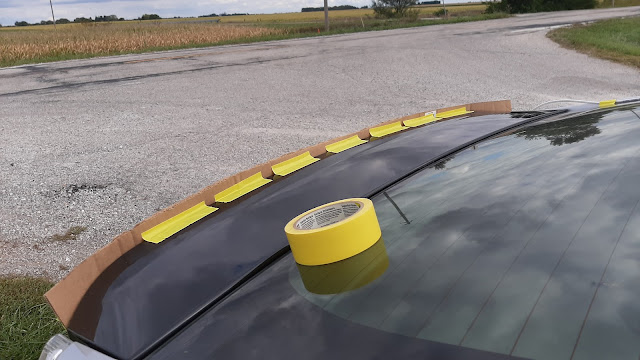
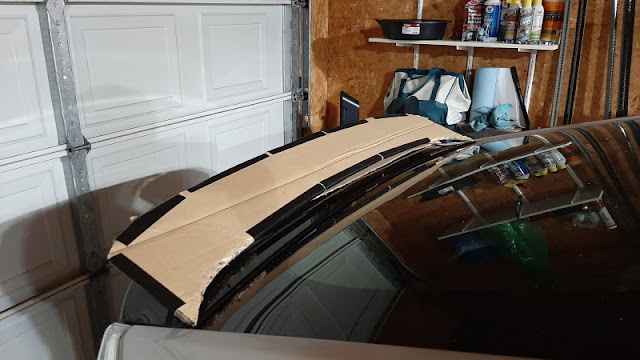
When I first figured out that guessing at aerodynamic changes is stupid and that I could test things and learn how modifications to my car actually affect the air flowing around it, one of the first devices I tested was a lip spoiler . This spoiler was a strip tape-type, which are cheap and easy to install on any car. Despite being less than an inch tall, the lip spoiler increased pressures over the rear window and roof by as much as 30 Pa—a substantial change for something I thought would have little to no effect! Fast forward two years and the spoiler has reached the end of its life: I discovered on a recent trip that the tape had begun to fail and the spoiler was coming loose.   Since the lip spoiler would have to be removed anyway, I decided to use this as an opportunity to conduct some more investigations into the behavior of a spoiler on my car. I made a cardboard spoiler in the shape of the stock spoiler and cut out some angled spacers at 10 ° , 20 ° , and 30 ° : I got a...

Optimizing Aerodynamics of a Truck: Part 3

Image
Will this barn door reduce drag? Only one way to find out. In Part 1 of this series , I measured drag reduction on my 1991 Toyota pickup with the grill blocked and mirrors removed. In Part 2 , I did some qualitative flow testing, observing the behavior of wool tufts with a modified A-pillar and a bug deflector. Today in Part 3 we’ll go back to measuring drag reduction as we look at air dams.   How Do I Decide Which Test to Use? Before we get into it, an anecdote. When I learned to drive, I remember my instructor taking us out onto a 4-lane highway to have us practice changing lanes. Look in the mirror, check that the next lane is clear, signal, and move over, she told us. When my turn came, I glanced at the mirror and began to move over. Driver’s ed cars had right-side brake pedals, and she stomped on it. There was a car in the other lane I was trying to move into. “See what you’re looking for,” she said. When testing aerodynamic modifications, see what you’re looking for. ...

A Practical Guide to Aerodynamic Modification

Image
Updated August 15, 2023 Tuft testing shows the streamlines on a car as the yarn aligns itself with airflow while you drive. Gas prices have recently reached their highest level in nearly a decade. You may find yourself looking at your car, wondering if it’s possible to use less fuel on your long commute and keep some money in your pocket. You may have heard of people who modify their cars to get better fuel economy. You might have even seen cars like the Aerocivic, a weird-looking contraption that was reported on in mainstream media articles during the gas price spike of 2008-09. Would doing something like that work on your car? Can you modify the aerodynamics of your car at home? The good news is, you can! The better news is, you don’t have to (and shouldn’t) make your car look like the Aerocivic. Air drag has an influence on the fuel economy of cars, and that influence is greater the faster you typically drive. You can also do a lot more with airflow than just reduce drag. Many peo...