Posts

Showing posts with the label throttle stop

Optimizing Aerodynamics of a Truck: Part 5
Image
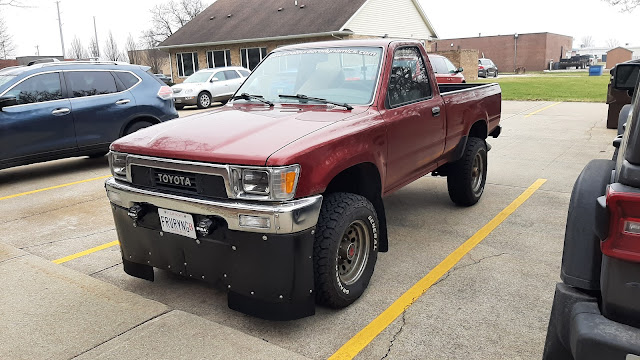
After my last round of testing , I made a permanent version of the air dam extensions I tested: This brings my truck’s aerodynamic drag down to around 84-85% of what it was before I started this project:   Modification Percent Change mirrors removed, grill blocked -4.0% 9” air dam -8.6% air dam extensions -3.8% Total -16.4%   I didn’t expect to get that much with these changes, especially because I haven’t even tested anything on or around the bed, rear undercarriage, tailgate, rear wheel housings, or rear bumper.   Tailgate   Many websites claim that lowering a truck’s tailgate increases its drag. This was even explored on an episode of the popular television show Mythbusters ; the show’s hosts put a model truck in a water tunnel to illustrate the recirculation that happens in the bed (and ran some fuel economy tests with the tailgate down, removed,...

Optimizing Aerodynamics of a Truck: Part 4

Image
So far, I’ve lowered the aerodynamic drag of my 1991 Toyota Hilux by removing its mirrors, blocking part of the cooling air opening , and fitting a large front air dam . Together, these reduce drag by more than 10%--which means I’m about halfway to my goal of cutting the drag of this truck by 20% or more .   Moving on from the front surfaces, I thought I would trial some modifications to the airflow around the wheels next.   Keep It Simple   Right off the bat, I have a conundrum. The front wheel housings have a metal inner fender and a narrow plastic cover which seals the gap between inner and outer fenders. But in front of the tires, there are effectively no wheel housings; it’s open to the bumper, stock valance, and now air dam. According to various textbooks , wheel drag is typically reduced when wheels are enclosed in housings, with drag decreasing the smaller the ratio of the wheel housing volume to wheel volume. This may or may not hold true on my truck; I hav...

Optimizing Aerodynamics of a Truck: Part 3

Image
Will this barn door reduce drag? Only one way to find out. In Part 1 of this series , I measured drag reduction on my 1991 Toyota pickup with the grill blocked and mirrors removed. In Part 2 , I did some qualitative flow testing, observing the behavior of wool tufts with a modified A-pillar and a bug deflector. Today in Part 3 we’ll go back to measuring drag reduction as we look at air dams.   How Do I Decide Which Test to Use? Before we get into it, an anecdote. When I learned to drive, I remember my instructor taking us out onto a 4-lane highway to have us practice changing lanes. Look in the mirror, check that the next lane is clear, signal, and move over, she told us. When my turn came, I glanced at the mirror and began to move over. Driver’s ed cars had right-side brake pedals, and she stomped on it. There was a car in the other lane I was trying to move into. “See what you’re looking for,” she said. When testing aerodynamic modifications, see what you’re looking for. ...

The "Should" Manifesto

Image
I used to talk about aerodynamic modifications on my cars—and remember, I had no idea if they worked or not because I had never tested anything—using the word “should” a lot. “Removing the mirrors should be reducing drag,” for example. “Adding this tail should make it a lot more streamlined.” “Putting these lowering springs on should lower drag.” “Taping vortex generators here should keep flow attached over this panel.”   Banish this word, “should,” from your vocabulary whenever you talk about aerodynamic modifications. The air doesn’t care about what you think it should do, and you’re most likely wrong anyway. This guy got it right. Mindset   That word, “should,” betrays a mindset of hoping that your modifications work without testing them to see if they do or not. If fear—of finding out they don’t work, of learning that you failed—is holding you back, see if you can approach aerodynamic modification with a different attitude. The Last Jedi had its problems, but it d...