Posts

Showing posts with the label template

How Spoilers Work

Image
ETA 2/28/2026: For a better explanation than this (which I wrote before enrolling in an aerospace engineering degree program), and better example of test methodology and data analysis, see my most recent post on spoiler testing. Buckle up, this one's long. After hanging around Ecomodder for years, I had a pretty messed up idea of the function of spoilers because of what I had read on that forum. You might too.   See, the prevailing theory there—based entirely on posts by one forum member who is widely seen as an aerodynamic “guru”—is that spoilers “reach out” to an ideal “template” profile . By so doing, the theory goes on, a “locked vortex” is captured and the airflow above the spoiler follows the “ideal” template line as the air just ahead of the spoiler recirculates. So, simply position a spoiler and extend it until it touches a template profile overlaid on a side-view image of your car and, voil à ! Lower drag—because the spoiler isolates negative pressure in front, higher pr...
Common Misconceptions in Aerodynamics: Part 2

Image
In the first installment of this series, I wrote about the fallacy of using a “template” to guide aerodynamic modifications . This second part brings us to a related topic: testing. Testing is an Absolute Necessity, Not an Unnecessary Frivolity   The claim: Since we know what the “ideal” shape looks like and can predict airflow over a car, all we have to do is build something to that shape and it will be guaranteed to work. There’s no need to test anything.   Eliminating guesswork by...more guessing. Sounds legit. The reality: Because of the complexity of the flow around a car, “automobile aerodynamics is still dominated by empiricism,” as Hucho wrote in Aerodynamics of Road Vehicles . Simulations have replaced some of the development previously done in wind tunnels as computers have become more powerful and faster, but there is still no way (and likely never will be) to design a low-drag car by following simple principles of shaping such as the “template” discussed previou...

Common Misconceptions in Aerodynamics: Part 1

Image
Frequently, online articles or forum posts about aerodynamics are succinct, with simple explanations and guidelines for modifying your car. The problem with a lot of these is that they are wrong . Not just fuzzy on a few details here and there but outright, completely, 100% incorrect. They are not borne out by the vast body of literature on car aerodynamics or by direct, hands-on experimentation. The counter to these, unfortunately, cannot be as simple because, as we will see, the science of air flows is by its very nature complex and hard to understand. This series will argue against some of the most insidious myths, debunked with my own test results and citations from experts as supporting evidence (which I encourage you to read for yourself ). Aerodynamic "Templates" and "Ideal" Shapes Aren’t Applicable to Real Cars   The claim: Everything we need to know about car aerodynamics was discovered in the 1920s. Using a single ideal profile, we can create a universall...

A Practical Guide to Aerodynamic Modification

Image
Updated August 15, 2023 Tuft testing shows the streamlines on a car as the yarn aligns itself with airflow while you drive. Gas prices have recently reached their highest level in nearly a decade. You may find yourself looking at your car, wondering if it’s possible to use less fuel on your long commute and keep some money in your pocket. You may have heard of people who modify their cars to get better fuel economy. You might have even seen cars like the Aerocivic, a weird-looking contraption that was reported on in mainstream media articles during the gas price spike of 2008-09. Would doing something like that work on your car? Can you modify the aerodynamics of your car at home? The good news is, you can! The better news is, you don’t have to (and shouldn’t) make your car look like the Aerocivic. Air drag has an influence on the fuel economy of cars, and that influence is greater the faster you typically drive. You can also do a lot more with airflow than just reduce drag. Many peo...

Introduction: Part 3

Image
My attitude hadn’t changed when, a few years later, I purchased the car I really wanted: a 2013 Prius. Here was a vehicle that had undergone significant aerodynamic development; Toyota advertised at the time that the third-generation Prius had spent more hours in a wind tunnel than any of the manufacturer’s other cars up to that point. Imagine my surprise, then, when I found that the forum members on Ecomodder thought there were significant problems with the car. I don't even have a picture of it stock; I got right to work modifying it according to "conventional wisdom." Specifically, their issue was with the taper of the roofline profile. Members were fond of using the Template as a litmus test for assessing the aerodynamic performance of cars based solely on comparing pictures. The user behind the Template went so far as to brand this “dimensional analysis,” giving it an incredible air of authority with the site’s other members. Someone had superimposed the Template ove...

Introduction: Part 2

Image
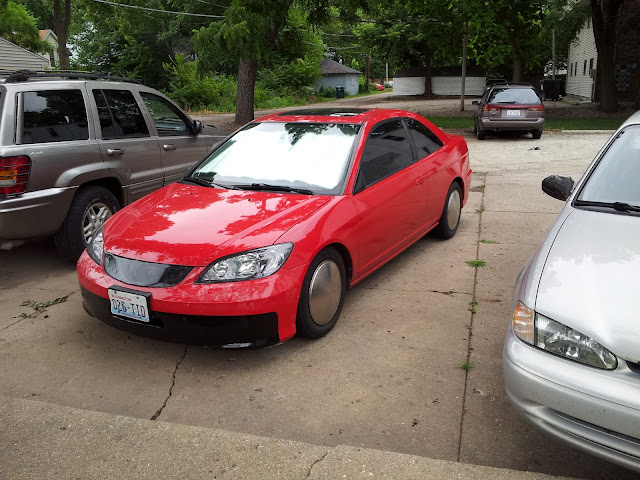
 There is a list of “65+ Efficiency Mods” on the Ecomodder website, a sticky at the top of one of the subforums. Some of the suggestions are engine- or drivetrain-related, but a fair number are aerodynamic. These range from removing roof racks to fitting solid wheel covers to building the full “boat-tail” that Ecomodders are sort of known for now, mostly through the efforts of one forum member who originated the Aerodynamic Streamlining Template (I’ll call it the “Template” from here on) as the cure-all for every aerodynamic problem. I decided to implement some of the most popular modifications on my 2005 Civic, in addition to some of my own such as removing the power steering system. I took off the exterior mirrors and bolted small convex mirrors to the sail panels inside. I blocked off most of the cooling air intake in the front grill, first with sheet metal and then with spray foam, shaped and fiberglassed to give a smoothly rounded front with a small inlet duct sized just l...