Posts

Common Misconceptions in Aerodynamics: Part 5

Image
Continuing this series of posts , now we'll look at a more practical--and more popular--fallacy. Waxing Your Car Does Not Reduce Its Drag The claim: Clean and wax your car’s paint and the air will slip smoothly past it, reducing drag. This screenshot comes from--surprise!--a website for a carwash chain. There you have it; Internet wisdom at its finest ("we agree, so this must be true"). The reality: This one pops up on forums and online articles all the time. Unfortunately, it is a misconception that seems like it should be true: if fluid/air flows past the car body, making that body more “slippery” by waxing it should help the air move past more easily, right? Wrong.   What we’re dealing with here is a fluid boundary or “interface.” Interfaces can occur between fluids and solids or between different fluids (think of an oil slick floating on water or better yet, wind rushing over the open ocean; these are both examples of fluid interfaces). At these interfaces, strange, n...

Optimizing Aerodynamics of a Truck: Part 3

Image
Will this barn door reduce drag? Only one way to find out. In Part 1 of this series , I measured drag reduction on my 1991 Toyota pickup with the grill blocked and mirrors removed. In Part 2 , I did some qualitative flow testing, observing the behavior of wool tufts with a modified A-pillar and a bug deflector. Today in Part 3 we’ll go back to measuring drag reduction as we look at air dams.   How Do I Decide Which Test to Use? Before we get into it, an anecdote. When I learned to drive, I remember my instructor taking us out onto a 4-lane highway to have us practice changing lanes. Look in the mirror, check that the next lane is clear, signal, and move over, she told us. When my turn came, I glanced at the mirror and began to move over. Driver’s ed cars had right-side brake pedals, and she stomped on it. There was a car in the other lane I was trying to move into. “See what you’re looking for,” she said. When testing aerodynamic modifications, see what you’re looking for. ...

Optimizing Aerodynamics of a Truck: Part 2

Image
  In Part 1 of this series, I showed how to use throttle-stop testing to a) get reliable measurements of changes in drag, and b) how to use this measurement technique to test some simple modifications—blocking the cooling air intake at the front of the truck and removing the side mirrors. Together, those amounted to a 4% reduction in drag, so after the test was completed I made permanent versions of both aerodynamic modifications: Next up, we’ll look at one outlandish modification and one typical change that a lot of pickup truck owners make.   Modifying A-Pillar Flow   When I go to auto shows, I take lots of pictures of details on production cars. One of those fascinating details is the prevalence of what I call “fenced” A-pillars; that is, the windshield is slightly inset below the A-pillar and a sharp edge on the pillar stands proud of the glass: Here's an example, on the 2019 Hyundai Elantra. My truck is an older design and doesn’t have this edge. Instead, the wind...

Common Misconceptions in Aerodynamics: Part 4

Image
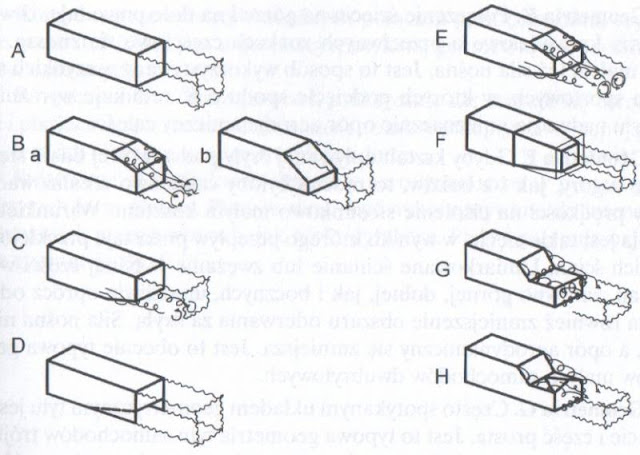
Now that we've looked at the fallacy of using templates to guide aerodynamic modifications , the necessity of testing , and the complicated nature of aerodynamics , today these all come together in the false idea that airflow can be predicted or intuited. Intuitive Design Is Not an Effective Approach to Reducing Drag The claim: Since airflow can be predicted with complete certainty and behaves according to simple principles, it is similarly possible to predict the aerodynamic performance of any design by using intuition. It's so easy--just absorb these (oversimplified) schematic representations of the theoretical flow over prismatic bodies. Just like a real car! The reality: Along with a severe phobia of testing aerodynamic changes, it seems that most—perhaps all—of us harbor the innate idea that we can ascertain whether a car has low drag or not simply by looking at it. In some cases this works: look at a 1932 Ford Model A coupe, for example, and you don’t need to see any numb...

Don’t Guess—Test!

Image
My truck, wearing its first, tested  aerodynamic modifications. It kills me sometimes to see people going on forums and asking questions about how to aerodynamically modify their cars. Why? Because almost inevitably they get a stream of answers that state, quite confidently and often unequivocally, that such-and-such a change will lower drag by x amount, or that a specific modification will always reduce drag, or what the dimensions of a modification should be for maximum, “guaranteed” drag reduction.   Often the people answering these sorts of questions will point to research on simple bodies (these are frequently used to justify guidelines on tapering of boat tails, for instance) or papers on the development of production cars (data on cooling system drag or optimum backlight angle, for example) or studies of modifications on production cars (the most famous is a 2012 investigation of changes to an Audi A2 run by Tata Motors, Jaguar Land Rover, Warwick University, and others...

Common Misconceptions in Aerodynamics: Part 3

Image
The first part of this series dealt with the erroneous use of "templates" to guide aerodynamic modifications , and the second part with the belief that testing is unnecessary or impossible to do at home or both . Now, we'll take a look at the prevailing belief that aerodynamics is an easy subject. Aerodynamics are Extremely Complicated The claim: The principles of fluid dynamics that govern airflows are simple to understand; therefore, aerodynamics as a whole are actually simple. Anyone who says or thinks aerodynamics are complicated is just muddying the waters. There's so much wrong in this forum post, I'm not even sure where to start. The reality: Hand-in-hand with the idea that airflows can be predicted and low drag is as simple as following a template, the belief that aerodynamics are easy to understand (a prerequisite for their ease of prediction) is just as erroneous. The aerodynamic force exerted on a body like a car arises from the pressures acting on it...

The Relationship Between Drag and Fuel Economy

Image
Lined up and ready to head out on track at the 2022 Green Grand Prix , an annual fuel economy competition held the Friday of opening weekend at Watkins Glen International. We all know that reducing drag can improve fuel economy. It’s intuitive but can be proven mathematically: when your car has less force acting against it, it takes less fuel (gas, diesel, or electric) to move. But what is the exact relationship between aero drag and economy? Can we measure it? Or predict it? Figuring this out can help us plan modifications to our cars with the aim of improving economy, as well as tell us if fuel economy is an accurate measure of changes in drag. ETA 5/18/2026:  Since writing this post, I've learned more about how to model fuel economy in cars. It comes down to efficiency (thermal, propulsive, and overall) the magnitude of resistance force, and the energy available in fuel sources like E10. See  this article on efficiency for a better explanation,  how to evaluate online ...