Posts

How Spoilers Work

Image
ETA 2/28/2026: For a better explanation than this (which I wrote before enrolling in an aerospace engineering degree program), and better example of test methodology and data analysis, see my most recent post on spoiler testing. Buckle up, this one's long. After hanging around Ecomodder for years, I had a pretty messed up idea of the function of spoilers because of what I had read on that forum. You might too.   See, the prevailing theory there—based entirely on posts by one forum member who is widely seen as an aerodynamic “guru”—is that spoilers “reach out” to an ideal “template” profile . By so doing, the theory goes on, a “locked vortex” is captured and the airflow above the spoiler follows the “ideal” template line as the air just ahead of the spoiler recirculates. So, simply position a spoiler and extend it until it touches a template profile overlaid on a side-view image of your car and, voil à ! Lower drag—because the spoiler isolates negative pressure in front, higher pr...
Testing and Improving Stability: Part 1

Image
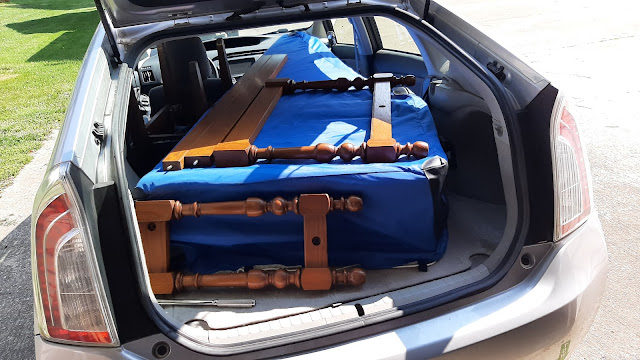
Driving back and forth to a city about an hour and a half from here for rehearsals and a concert recently, I wondered if I could measurably improve the stability of my Prius. I was transporting and playing this, a 2008 Zuckerman Flemish double harpsichord. You can buy kits to put an instrument like this together yourself. As it usually is here in the Midwest, it was windy all three days I had to make that drive and I found myself paying attention to how much I had to turn the steering wheel to keep the car going straight down the freeway. I wondered, is it possible to give my car better directional stability? And could I measure anything that would tell me, objectively, if a change I make has an effect?   Defining “Stability”   Stability, in aerodynamics, is a complicated subject. It depends not just on the aerodynamic characteristics of a car but also how these interact with the car’s suspension, tires, weight distribution, and handling tendencies. It also depends on how the...

Optimizing Aerodynamics of a Truck: Part 4

Image
So far, I’ve lowered the aerodynamic drag of my 1991 Toyota Hilux by removing its mirrors, blocking part of the cooling air opening , and fitting a large front air dam . Together, these reduce drag by more than 10%--which means I’m about halfway to my goal of cutting the drag of this truck by 20% or more .   Moving on from the front surfaces, I thought I would trial some modifications to the airflow around the wheels next.   Keep It Simple   Right off the bat, I have a conundrum. The front wheel housings have a metal inner fender and a narrow plastic cover which seals the gap between inner and outer fenders. But in front of the tires, there are effectively no wheel housings; it’s open to the bumper, stock valance, and now air dam. According to various textbooks , wheel drag is typically reduced when wheels are enclosed in housings, with drag decreasing the smaller the ratio of the wheel housing volume to wheel volume. This may or may not hold true on my truck; I hav...

Measuring Pressure Changes With a Spoiler: Part 3

Image
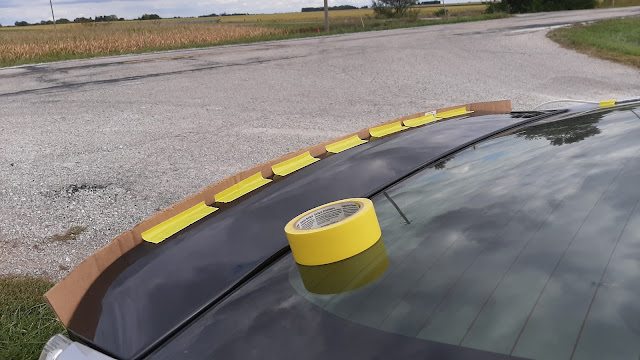
  This summer, I tested a large spoiler at different angles, with and without fins , by measuring pressures on the rear window and base of a Prius.   Recently, I tested two variations on this. First, a Gurney flap is a short vertical spoiler placed at the trailing edge of bodywork or an existing wing or spoiler. I made a flap out of cardboard, about an inch high: Then, after reading about possible beneficial effects from a spoiler with a wavy edge rather than straight, I made another cardboard strip with a sinusoidal shape: Would there be any difference between the two?   Lastly, I took the 20 ° spacers I had fabricated for my previous test and taped the spoiler board to them, but this time with a slot or opening at the bottom. How would this compare to a spoiler with no slot? Results   As one might expect, the Gurney flaps did not increase pressure on the window as much as the large spoiler. And there was no difference in window or base pressures between the s...