In
aerodynamics engineering, we talk about pressure a lot. But what is
pressure anyway? It's something we're all familiar with in our everyday lived
experience: your ears "popping" when you drive up a mountain due to the
pressure change with altitude; feeling drained or tired after a long flight
in a cabin at a different pressure than what you're used to; sticking your
hand out a car window and feeling the "push" of the air backward. You might
even remember from a physics or chemistry course that pressure arises from the
molecules in a gas zipping around, occasionally bouncing off a surface, and that
the faster they move, the greater is the pressure the gas exerts. "Movement" implies velocity alone, but of course the number and mass of these molecules also matters:
more mass, greater pressure. Mass and velocity multiplied give momentum,
and pressure arises from the transfer of momentum between molecules in a gas
and any surface in contact with that gas.
 |
| The propane in this tank exerts a force on the tank walls due to its high pressure (hence its robust construction), but the net force on the tank is zero. Each molecule of propane has a mass (44 g/mol) nearly 60% greater than the averaged molecular weight of air (29 g/mol). |
As
we can guess, since pressure is dependent on the momentum of molecules in a gas
as they move around, it is related to temperature—which is a measure of how
much energy those molecules have—and density—which is a measure of how much molecular mass there is in a given volume. These are all related in an equation
called the "Ideal Gas Law" which states, in its most common and useful formulation
in aerodynamics engineering,
…where
p is the static pressure of the gas, T is the static temperature
of the gas, ρ is the density of the gas, and R is the "specific
gas constant," measured in units of energy per mass per temperature (work that out and you will find that another way of writing pressure is "energy per volume"). "Specific" implies that this is related to the mass or density of a gas, and
this means that any gas has a unique R (but the universal gas
constant ꭆ is, as the name suggests, unchanging; R is given by ꭆ
divided by the molecular weight of the gas in question). Rair
in both metric and English units is, (°R
is temperature in degrees Rankine, and K is temperature in Kelvin—these are
absolute measurements. Be careful of these, since most of us are accustomed to
temperatures given in °F or °C in day-to-day life).
Using
the Ideal Gas Law, we can easily find the pressure, temperature, or density of
a gas if we know its other two properties. So, you can find ambient density if
you measure absolute air pressure and absolute temperature, for example.
Differential
(Gauge) vs. Absolute Pressure
"Absolute" and "differential" refer to differences in reference. Absolute
pressure, as you might guess, is referenced to a vacuum, or zero pressure; consequently, absolute
pressures such as ambient static pressure are usually quite large. For example,
standard atmospheric pressure at sea level is 101.325 kPa or 2,116 pounds per
square foot (psf).
Differential pressure is also called
gauge pressure. This is a pressure measurement referenced to another
nonzero pressure. Why is this useful in aerodynamics engineering? The resultant force from a constant
pressure around any closed surface (like atmospheric pressure acting on your
car while it sits in your driveway, which includes its interior surface since it is not airtight—unlike the propane tank above) is 0; the shape and symmetry (or asymmetry)
of the surface do not matter. In other words, while your car is stationary
relative to the air mass on a perfectly calm day, the static pressure of the
atmosphere does not exert any imbalanced force on it. All the pressure pushing
down on the top of the car is balanced by pressure pushing up on the bottom;
all the pressure pushing on one side is balanced by pressure pushing on the
other side; all the pressure outside pushing in is balanced by pressure inside pushing out, and so forth.
If
you get in and start driving (or if a wind picks up), now there will be
relative motion between the air mass and car body. This relative motion—the air
now flowing around and through the car, over its entire "wetted" area—results in pressure variation over and inside the body. Because the pressure
acting everywhere on the car is no longer constant, these variations in
pressure produce an imbalanced force. This force is proportional to the
pressure differences from atmospheric, so to measure them we are
interested in differential or gauge pressure rather than
absolute.
Think
of the absolute atmospheric pressure as a floor in an upper story of a tall
building which is some height above the ground. If you stand on the floor, your
potential energy relative to the ground is quite large but your potential energy
relative to the floor is quite small (nonzero because your center of gravity is somewhere above your feet). Stand on a chair and your potential energy goes up,
but since you'll simply return to the floor if you jump off the chair it is your
height relative to the floor, not the ground, that really matters as far as the
force you will experience on landing. It's the same with static pressure on
your car. Since we have a "floor" of atmospheric pressure that all cancels out
anyway, it's the difference relative to that atmospheric pressure that really
matters.
Classification
of Pressure
The
Ideal Gas Law is a relationship we call an "equation of state." That means that
it is not dependent on motion or path, and the values the Ideal Gas Law
predicts are static. Static pressure (p) is the pressure exerted
by air due to the internal momentum of its molecules—air that is, on a
continuum level (see below), not in motion.
Another
pressure that has great significance in aerodynamics engineering is dynamic
pressure (q)—pressure associated with the movement of an air mass. This
is related to the kinetic energy in a continuum flow (of sufficiently
large scale that it behaves continuously—as a fluid and not as individual particles)
and is given by, …where
u is the velocity of the air. This value is important because aerodynamic
forces are proportional to it (since the force acting on the car from pressure and shear variation is referenced to the static pressure of the atmosphere, which by itself
produces no force—so these variations overall and their resultant force must be proportional to the
dynamic pressure).
To
get a measure of the total energy in moving air, sum these together to get total
pressure (p0): …where
k is some constant, and it only applies with a number of assumptions
like inviscid flow (no shear), irrotational flow (the orientation of any infinitesimal
fluid element does not change as it traverses its path along the flow), no body
forces (negligible effect of gravity), steady state (no time variation), etc.
In real flows, the Bernoulli equation only applies along streamlines outside of
the boundary layer that forms around the entire body surface and outside of the
wake that forms behind every submerged moving body (yes, even completely
streamlined ones!).
 |
| Physically, this is because even a fully streamlined body, like this NACA 3310 airfoil (blue), develops a boundary layer (red). |
As
a car moves through air, total pressure is lost through dissipation in shear
layers. Anywhere there are "layers" of fluid moving at different speeds, shear
stress (friction) between these layers dissipates energy. So, at the front of
your car there is some total pressure available which is larger than the total
pressure behind the car. In fact, we can measure the drag of an object by
measuring these losses:
…as
in this lab experiment, where we measured the velocity difference between the
flow upstream and downstream of a cylinder, which is proportional to the loss
in total pressure and gives us the sectional drag force D' acting on the
cylinder in the plane of measurement.
Measurement
Devices
There
are two types of device that can measure pressure. The first is a barometer:
Barometers
measure absolute pressure. I use this digital barometer to record atmospheric
pressure during testing. Many digital barometers can display pressure in
different units, making it convenient and easy to switch between English and
metric as you prefer.
The
other type of pressure measurement device is a manometer. Manometers measure
differential pressure. They have two ports, one reference pR
and one test pT, with the displayed value calculated as,If
you confuse the reference and test ports and connect things backward, it just
switches the sign of the output—an easy correction.
Manometers
come in several different types. The most basic is a tube of water bent into a "U" with lengths marked on the tube, called a water gauge:
 |
| Notice that the length scale here is calibrated to give vertical displacement. |
These
may seem old-school but I've used one professionally on many occasions, to
measure wind pressure in pipe organ windchests, since you can make one in a
pinch with some tubing and a ruler. Higher pressure on one side pushes the
water column down on that side and up on the other, with the output (the vertical difference in height—this is important!) typically measured in "inches of water" or inH2O.
Next,
Dwyer Magnehelic gauges are a popular choice of manometer for their accuracy
and reliability. This is another device I've used a lot as an organ builder:
These
are available in a variety of display units in both English and metric, and as
positive output only (like this one) or positive and negative.
Digital
manometers are available in a variety of flavors from various companies and
retail outlets. Even the most basic digital manometer is more useful for
measuring aerodynamic pressures than a water gauge or Magnehelic, I've found,
since almost all of them have the ability to record and display average pressure:
As
with the digital barometer, digital manometers usually have the ability to
display pressure in a variety of units. Another advantage over the water gauge
or Magnehelic: digital gauges are not sensitive to orientation.
Finally,
much more expensive (if you can even find somewhere to purchase them) and
typically not seen outside of a laboratory, scanners are the ne plus ultra of
pressure measurement:
Pressure
scanners can record multiple channels at once and usually connect to a computer
for logging and displaying measurements over time. These are out of reach to
most consumers but can greatly improve testing efficiency if you have access to
one by recording 8 or 16 pressure measurements simultaneously. (If any of you
have a lead on where or how to acquire a scanner cheaply, message me. I would
kill for one of these).
Probes
The
other side of pressure measurement is the input or probe, placed at the
location(s) where we want to take a measurement and connected to the measurement device with vinyl or silicon tubing. Static probes have ports
(openings) in a plane parallel to the flow. These can be built into a pitot
tube:
…or
a patch that can be taped onto a surface:
…or
simply a tube end with the line taped into place perpendicular to the flow
direction, so that air flows across the tube opening:
All
of these measure static pressure.
To get total pressure we point the opening
into the flow so that the air decelerates to zero velocity inside the port (and
we assume this happens isentropically, or with no energy loss). This
port can be a tube:
…or
a patch on a vertical surface like a heat exchanger:
Finally,
to find dynamic pressure we can't really just measure it with a single probe. Instead, rearrange
the equation for total pressure above to see that,So,
take the differential pressure between total and static to find q.
Often, these total and static ports are integrated on the same pitot tube but I
prefer to separate them:
I'm
not alone in this, and the reason I prefer separate
total and static probes is that this reduces error in the measurement. When
static ports are placed on a small tube that has a total port on its front, the "stagnation" (zero velocity) condition imposed at the front of the tube can
affect the static reading downstream. In a wind tunnel calibration experiment
last year using an array of pressure probes in the test section, my group (and other lab groups in the same class) found
that this resulted in more than 10% error in dynamic pressure calculation
compared to separate total and static probes:
To
check the accuracy of your measurements, you can calculate velocity from
freestream dynamic pressure (using the Ideal Gas Law to find air density at the
time of testing) and compare to your car's indicated speed and ambient wind
speeds that day, if any. Average the measurements taken in opposing directions
and you should get a velocity close to the speed of the car (displayed on the
speedometer or read through the OBD system; the speedometer is usually 1-2 mph high).
Calculating this using data from a recent test session shows:
…speed
given on the speedometer is a little above true air speed, exactly as expected.
Pressure
Coefficients
Lastly,
once you have measured pressures it will be useful to nondimensionalize them.
This is standard engineering practice (and something that I didn't know to do
until I went to school for aerospace engineering). Nondimensional pressure
coefficients allow easier observation of sensitivity to parameters like Reynolds number Re, normalize absolute values to divorce them from ambient
conditions like air density and speed, and allow for easier comparison of test results
and determination of behavior.
Static
pressure coefficient CP is given by the ratio of static gauge
pressure to dynamic pressure:This
is the most common pressure coefficient, but you may occasionally come across a
total pressure coefficient as well, CP,tot: The "∞" subscript in these refers to freestream conditions i.e. the flow somewhere away
from the car body. Place your static and total freestream probes on a pole at
the front of the car, for example, to measure these values.
Examples
Pressure
measurement can be used to determine the performance of lots of systems on your
car, from external flows to cooling system airflow to engine air intakes to
cabin ventilation. Here are just a few examples:
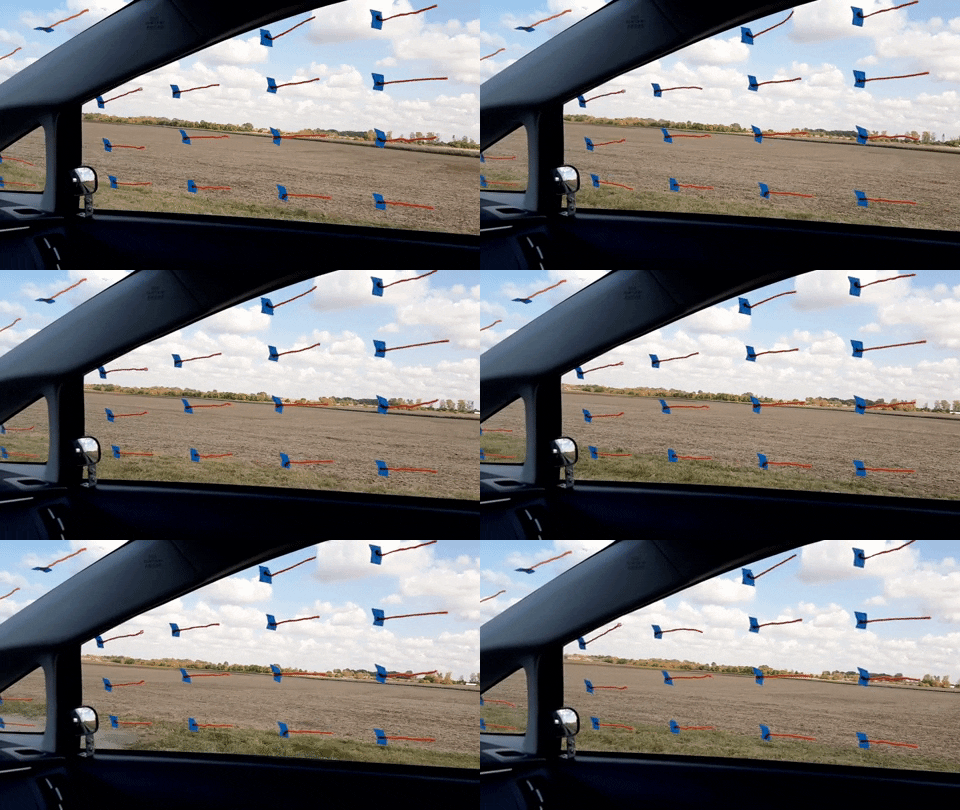
Air
inlet capture area:


Good educational topic, thank you. But, yes which device do you use to measure the pressures.
ReplyDeleteI have messed up with radiator shroud and radiator fan size and fan blades number on a 1985 Jeep Grand Wagoneer
For differential pressures, I use a digital manometer. Google "digital manometer" for lots of results.
Delete