One
of the unfortunate realities of cooling system modification and testing is that
we can't visually observe what goes on under the hood while the car is driving.
Building a physical model of the cooling system may shed some light on what the
real system is doing and can be designed for easy observation if you make a
window one side of the duct.
 |
| The air filter here functions the same as a heat exchanger in that it restricts flow and dissipates energy in the form of total pressure loss. |
Similar
to the real cooling system as I decided to analyze it in the previous post,
this model has no nozzle outlet. Instead, we have the same as we get in an
engine bay: a pressure boundary, meaning an enforced static pressure
behind the heat exchanger. Here, that is simply ambient pressure (CP
= 0). While it is not possible to vary atmospheric pressure here, we saw in
Part 5 (and will revisit later on) that modifications such as vents can change
engine bay static pressure and thus the boundary or outlet conditions on the
real exchanger.
What
we can change here are the inlet conditions. Here's what the flow looks
like with the duct as is, an inlet area about half the size of the filter with
a smooth-sided duct (I did the curve by eye, so these results were pleasantly
surprising):
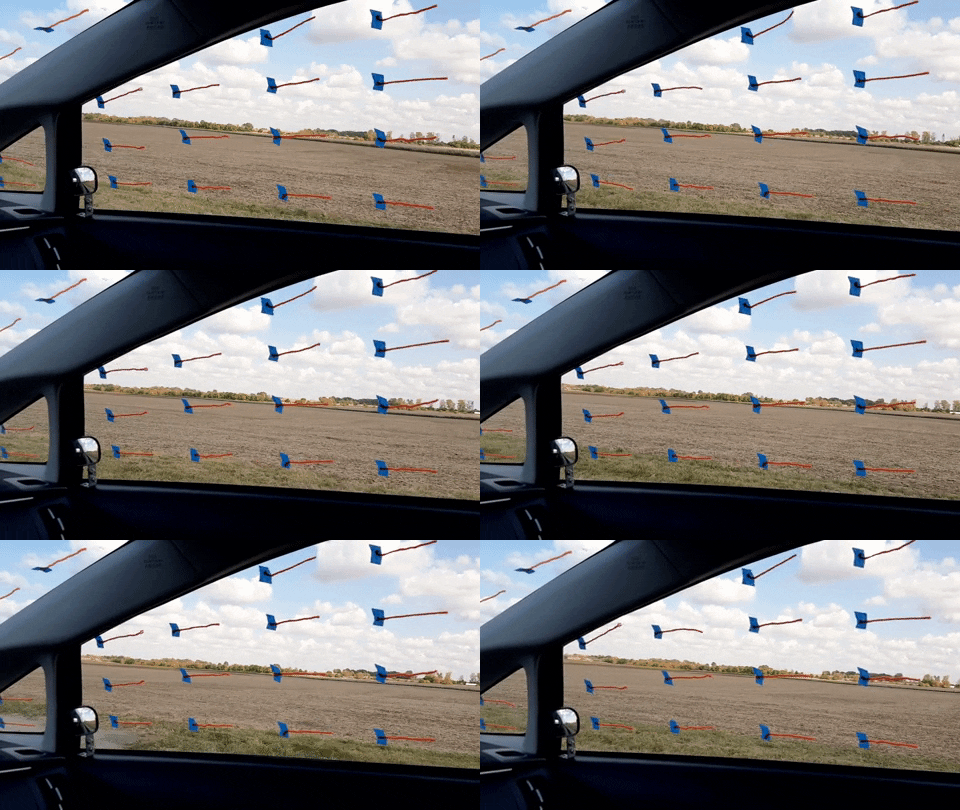
In
this condition, the static pressure difference measured in the center of the
filter is about 240 Pa at 75 kph and the tufts show good flow across the whole
filter. Blocking half the inlet with a board, either top or bottom, reduces
that static pressure difference to 0 Pa. However, as you can see below, in
this condition there is still flow through the filter (even accounting for the
lower tuft closest to the window, where there is some leakage around the
filter):

The
tufts reveal something important: conditions are not uniform across the filter
(you can see above how they change when the inlet is blocked on either the top
or bottom), and they aren’t uniform across the real heat exchanger under the
hood either. Even if you measure 0 static pressure drop across the heat
exchanger at some location, it doesn’t mean there is no
flow through it (as I wrote before, incorrectly!). Further, as we saw in
Part 4, the dynamic pressure on both sides of the exchanger will tell us the
flow velocity into and out of it, and the total pressure loss across the
exchanger reflects its drag, cooling capacity, and the direction of flow.
Static pressure measurement alone will not give you enough information about
the flow through the exchanger to determine cooling system performance on your
car. We'll revisit this idea in just a minute.
Core
Area and Flow Through Ducts
(Before reading this next section, brush up on your definitions of pressure by going through this explainer. The differences between static pressure, dynamic pressure, and total pressure figure heavily in the following discussion).
Recall
this chart from Part 4, of dynamic pressure out of the heat exchanger package
on my car compared to dynamic pressure in:
…and
this chart from Part 3, of velocity into the core as a fraction of freestream:

These
actually show us the same thing we can observe in the tufts taped to the model.
Measured q2 and q3, with a large
difference that cannot be explained by density change alone, show that u3
<< u2. What this means is, due to conservation of mass,
A2 (streamtube area into the core) is actually much smaller
than A3 (streamtube area out of the core), a conclusion that
is corroborated by measured core velocity ratio. Inlet area to core area on my
car is approximately 0.37, which means the velocity ratio at the heat exchanger
should be about the same fraction. But it isn’t; it’s much higher at 0.50. This
means the car is not using the whole heat exchanger core area! I may be able to
change this by fabricating a smooth inlet diffuser and modifying outlet area
and static pressure in the engine bay. As we saw at the end of Part
4, increasing core area and decreasing velocity will reduce drag from the heat
exchangers.
This
brings up an important point regarding the difference between our air filter
model and the real heat exchanger: namely, this model doesn't exchange any
heat. We aren't adding energy to the flow, so all the energy that comes into
the filter as static enthalpy and kinetic energy must go out as static
enthalpy, kinetic energy, and dissipation (increased entropy and work done on
the filter through shear and the no-slip condition, which is also responsible
for the drag force on it). The implication of this is, the velocity of the air
coming out of the filter must be less than the velocity going in;
however, continuity stipulates that these velocities should be equal in this
case (constant area and density, since we aren't changing the temperature of
the air). This leads to the conclusion that the flow properties across the
filter cannot be uniform, as this would violate the conservation
equations. Hence, just because we measure zero static pressure difference in
one location on the filter does not mean it is zero everywhere—it just
happens to be in that spot (or is too small to measure).
In
the real heat exchanger, the density of the air going out must be lower than
that coming in due to the fact that its temperature has increased. Since the
mass flow rate through the core must be constant at steady-state, real heat
exchangers have non-uniform flow properties across their cores and so can have a
different effective outlet area than inlet to satisfy continuity. We saw
this simulated in the first plot in Part 4:

Further,
because u3 is not the same as u2 and q3
is not equal to q2, the static pressure change is not equal
to total pressure loss across the heat exchanger (as we saw in Part 4, and you
can measure on your own car). What you should take from this, in conjunction
with the energy model in Part 4, is that if you want to see how a particular
modification affects your car's cooling, you should measure the difference in total
pressure (p02 – p03) not just static
pressure (p2 – p3). This corroborates what
we saw in our measurements across the heat exchanger core, where static
pressure loss on my car was only about half of total pressure loss.
And,
as always, don't just take my word for it—go read Hoerner: "The rate of flow
through the duct is a function of the difference in total pressure
between intake and outlet, and therefore a function of the internal losses of
momentum" [9-2, emphasis added]. This is true of any duct—e.g. engine air
intake, as Barnard specifically points out—not just the cooling system.
The
more momentum is lost in the duct, the less mass flow there will be through it.
Draw out and consider a duct with some arbitrary internal total pressure loss (due to its shape, surface texture, obstructions, etc.) and you
will see that it is perfectly possible to have flow through the duct even with
higher outlet static pressure than inlet if the duct is submerged in a flow
field (that is, if there is some velocity in the freestream to drive flow into
the duct). The static pressure change tells us the direction of the pressure gradient
and whether it is adverse (low to high) or favorable (high to
low) but it only tells us the direction of flow if u∞ is zero—that
is, if the car is stationary (and in this condition, we use something like a
fan behind the heat exchanger to create that static pressure drop, or engine
vacuum in the cylinders, or a fan in the HVAC ducting). When the car is moving,
the flow is driven by the relative motion between the vehicle and air mass, not just by static pressure changes (which, in a stationary air mass, are equivalent to
changes in total pressure). In fact, we can raise or lower static pressure at
any point in the duct simply by the choice of cross section area: larger area
gives higher static pressure and vice versa (the point you should have taken
from our discussion of diffusers and measurement on your own car).
I
used to think, based on reading lots of online resources that I now realize
were not quite correct, that measuring static pressure loss through a duct such
as an engine air intake or air curtain duct would tell me how well it flows, and that airflow could
only be "pushed" through a radiator on a moving car by static pressure drop. Neither
of these is true. Reality is much more complicated, but the upshot is that the
measures of how well a duct flows (i.e. how much energy loss there is in the flow through the duct) and the direction of flow through a duct or across a heat
exchanger are both given by changes in total pressure.
 |
| The second-generation Viper and Viper ACR used different throttle body tubes: ridged, accordion-style in the base car (top) and smooth in the ACR (bottom). The smooth tubes reduced total pressure loss enough, even in just that short distance, for Chrysler to certify a 10 hp increase in power output, from 450 hp to 460 hp, with no other changes to the engine. Think about why this is: with the same static pressure at the outlet (determined by engine vacuum), less total pressure loss through the tubes means greater dynamic pressure at the outlet, increasing mass flow rate. |
 |
| This custom airbox I added to my Viper when I owned it—long before I got into engineering at all—was, in retrospect, a very poor decision. The abrupt area change from the NACA inlet (the opening in the hood, at the top of the image) to airbox, compared to the smooth and gradual stock diffuser, almost certainly increased total pressure loss! |
If
you still don't believe me, consider a popular thought experiment you
may have encountered before. Say you have a car with a cooling air opening,
heat exchanger, and a completely sealed engine bay. Start driving the car, and
the engine bay soon fills up with air that cannot escape. Once the bay is
filled, there will be no more flow through the exchanger. Online, you've seen
this explained as the static pressure in the engine bay being high—which it is.
But in this hypothetical case, static pressure is equal to total pressure in
the engine bay. This is exactly the same thing that happens in a total
pressure port:

The
flow in the tube is stagnated (decelerated to 0 velocity) because it has no
escape route, and the sensor at the other end records total pressure. Similarly,
the zero-flow condition through our engine bay and heat exchanger occurs when
total pressure behind the exchanger equals total pressure in front of it. If
there is flow through the heat exchanger in either direction, there must be
total pressure loss across it (otherwise it would violate the 2nd
Law of Thermodynamics)—and, approximating energy added from the coolant as
negligible, the direction of total pressure loss tells us the direction of
flow. The same is true of engine air intakes, brake cooling ducts, cabin
ventilation intakes, air curtain ducts, etc. We'll see a mathematical explanation of this in the next post.
Grill
Blocks
Look
again at the video of the duct with a block in place. Closing down the inlet
area like this should, by conservation of mass, increase static pressure on the
front side of the filter. But clearly, it does not—in fact, the opposite occurs.
Why? Because we've massively increased the total pressure loss in the
duct.
With
no block in place, the static pressure increase on the front of the filter is
almost as much as freestream dynamic pressure q∞ (based on
speed and temperature at the time of testing)—which means the duct is
functioning very efficiently, with little total pressure loss and low ucore.
Closing down the inlet by blocking half of it also enforces a huge area of
separated flow behind the block, and that separation increases energy
dissipation and therefore total pressure loss. ucore may very
well be lower in this condition (I don't know since I didn't measure total
pressure at the filter), but with less available energy in the flow even a
small dynamic pressure doesn't leave as much static pressure available as
without the block. Looking back at past results of testing grill blocks and
measuring static pressure difference across the heat exchangers, this is
evident there as well although I did not know
enough to interpret those results correctly at the time.
This
gives us insight into grill blocking, a popular practice in the ecomodding
community. Blocking portions of the grill may reduce drag (by restricting mass
flow) but it is not the most efficient way to do that since it increases
momentum loss internally and reduces cooling capacity. We'll revisit this in
the next two posts, but if we approximate static pressure differences well
upstream and downstream of the cooling system as negligible then the internal
drag is given by the product of mass flow rate and velocity loss (revisit Part
4 to see how this is derived):By
restricting mass flow at the inlet, grill blocks reduce the first variable ṁ
but can increase the second term uin – uout (since
uin is constant, based on the car’s speed). It is better to
leave the inlet opening as is and reduce mass flow rate by changing the outlet
size, since this will reduce the streamtube area captured by the inlet, raising
static pressure at the opening, and maintaining more cooling capacity compared
to a simple grill block. Additionally, blocking the grill with sharp-edged
boards or plastic may increase total pressure losses even more, reducing
cooling system efficiency.

OEMs
use movable vanes in the inlet to block flow (rather than the outlet, which is
typically a very complicated "duct" with lots of restrictions and losses, even in electric vehicles like the Ioniq 9 above) for
one simple reason: it's cheaper, not because it's more effective. You
can copy them if you want, but you can also do a lot better. If you want to
close down the inlet opening, do so based on outlet area. And do it with both a
grill block and a smooth-sided diffuser duct to minimize total pressure
loss. That way, higher static pressure p2 (low ucore)
and high diffuser efficiency can be preserved. If you want to vary cooling
airflow—the point of those shutters—do it by closing or opening outlet area.
(Note
that some manufacturers also use vanes to direct flow upward or downward in the
diffuser duct, such as Rivian on their R1 series. If you want to experiment
with this on your car, these don't need to move or block off the opening if your
outlet is sized and conditioned properly).
Model
Revision
Since
the results of the first model were so interesting, I decided to revise the
duct to better reflect the dimensions of the cooling system in my car. Using
the same ratio of inlet height and diffuser length to core height as on the
real car, this looks like:
…with
the upper curve here approximating the shape of the bumper cover and a much shorter duct overall. Here's what
the flow looks like now:
And
with a smooth diffuser duct fitted inside, again approximating the dimensions
of what I could fit on the actual car (which means it has to fit underneath and
around the crash structure):
The
flow here in "stock" configuration is not as bad as I expected, although there
is still noticeable non-uniformity. Adding the interior duct improves this; the
tufts here look almost the same as with the longer, open duct above. I should
be able to shape the real duct better than this, with more curvature at the top
of the heat exchanger and a gentler curve around the bumper beam, so I expect
it to perform even better than this approximation, with an appropriately sized
inlet and perhaps modification of the outlet opening behind the fans.
How
big should our inlet and outlet be, and how should we go about modifying the system for lower drag and improved cooling? We’ll figure that out next time, when we step through the entire system from inlet to outlet in order to determine how to make it better.


Comments
Post a Comment